Doodlecillin
Doctor of Doodleology

(placeholder image)
Purpose
This sketchbook is a celebration of my abstract and doodle art, which is the foundation of my entire art practice. When I doubted my realism, I had my doodles, and now that I have advanced my realism skills, I can advance my doodles.
Structure
- Each page is it’s own, self-composed art piece. Primarily single pieces but sometimes I’ll throw in a spread.
- I will have composed pieces that take a long time and easy pieces I can finish in one sitting.
- I will be experimenting and pushing my art skills to their limits to see how far I can go.
My Brain
The “doodle confetti” pattern I do with my classic doodles is the representation of my brain. The tiny fine pieces that make the whole, chaotically thrown into piles and piles of hard-to-distinguish pieces.
Abstract vs Realism
Abstract has been my main form of art for most of my art history. I have dabbled in realism through it but it wasn’t until relatevely recently that I was able to bring my realism skill enough to enjoy drawing realism. I’ve been drawing realism for some time now.
I missed doing my doodle art and abstract pieces. I touch on abstract concepts in my Home Page, but never as far as my doodles could go. So I finally came back to doodles in Doodle Anatomy and eventually here in Doodlecillin,, and feel such a great connection that I took for granted before.
I question the meaning of my art and why I create what I create. I have felt lost, believing myself to not have meaning in my art. But the abstract stuff is my meaningful art. The realism is just fun, pretty things I like to draw. But the abstract and doodle art is where my soul is. It’s the reflections of who I am. Abstract art communicates who I am.
Sketchbook Goals
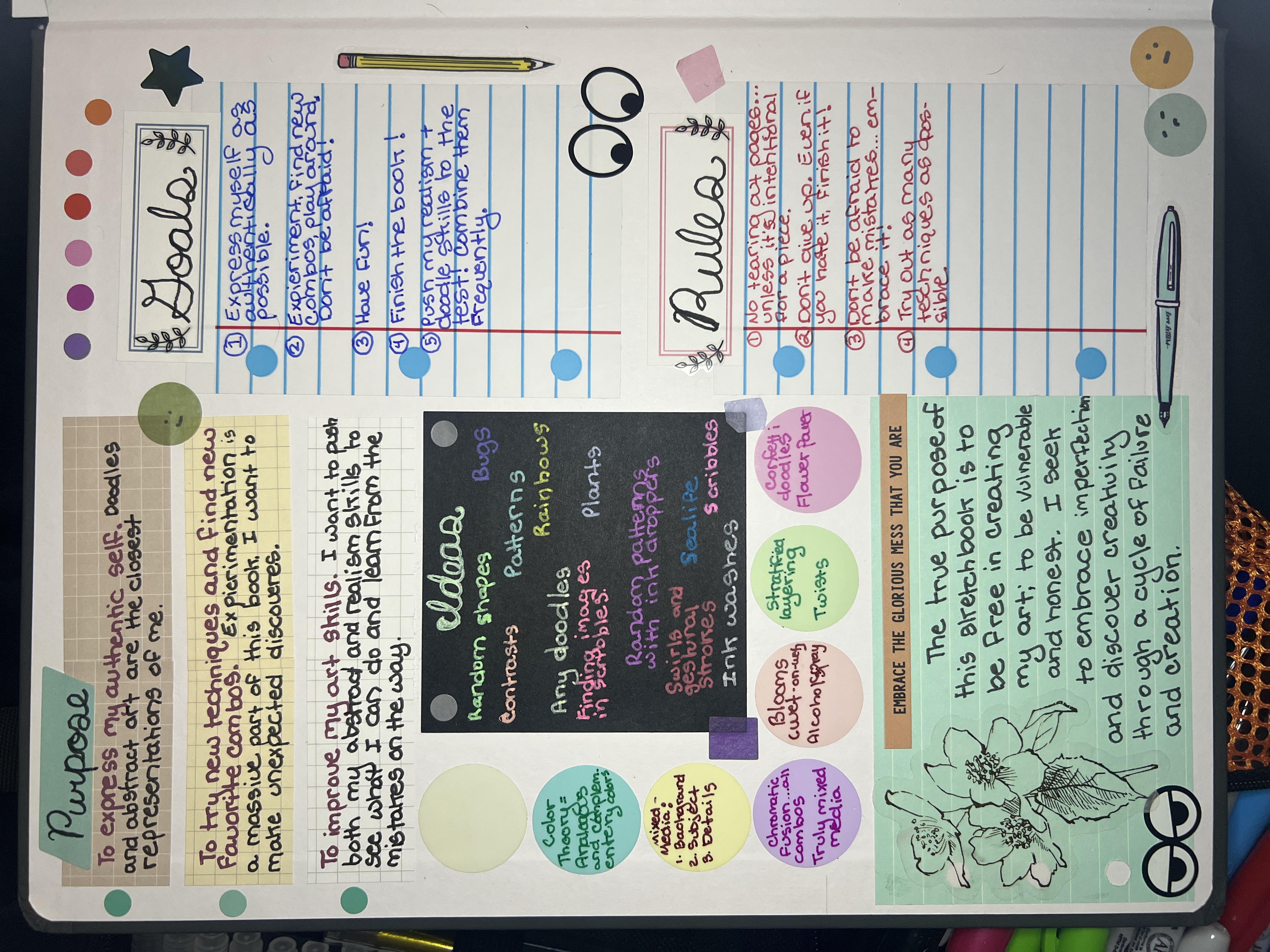
- Express myself as authentically as possible. My doodles and abstract art are the truest versions of me.
- Make things that make people do double-takes. I want very visually busy spreads.
- Have fun! Let loose and let go.
- Finish. I need to finish my sketchbooks.
Sketchbook Rules
- No tearing out pages. Let be what will be…unless tearing out pages (or pieces of pages) is part of the art piece. Then it’s ok.
- Experiment with abstract art. Do things I haven’t tried before. Combine abstract art with doodles to see where I can push my skills.
- Be truly mixed media. This is part of the experimentation. I have a lot of art supplies, I should use them.
- Learn from mistakes, don’t dwell on them.
List Of Stuff I Like Drawing
(Also a list of art block breakers!)
| Subject | Description |
|---|---|
| Ink Dropper | I like using the ink dropper to draw and splatter. Makes interesting shapes. |
| Stratified Layering | A very nice technique to sooth the mind. |
| Doodle Pattern Library | Ideas for when I need them of my doodles. |
| Bricks. | I like drawing bricks. And stone. |
| Patterns | Just fun to have patterns. Visually nice. |
| Zentangling | A classic. |
Creative Workbook
Strikethrough indicates idea is officially planned as a spread.
- Torn pages.
- Yin Yang related
- The original flower doodles “Flower Power”
- Stratified layering in colored pencil (but like the phoenix)
- Gellyroll (06) doodles
- A maze
- That alien looking design
- Actual Zentangle piece
- Using the dropper as the only source of drawing
- Using my glass dip pen to do my confetti doodles
- Lungs that are doodled on one side and mystic and colorful
- Something like this with paint randomly done in abstract flowers and reverse color them.
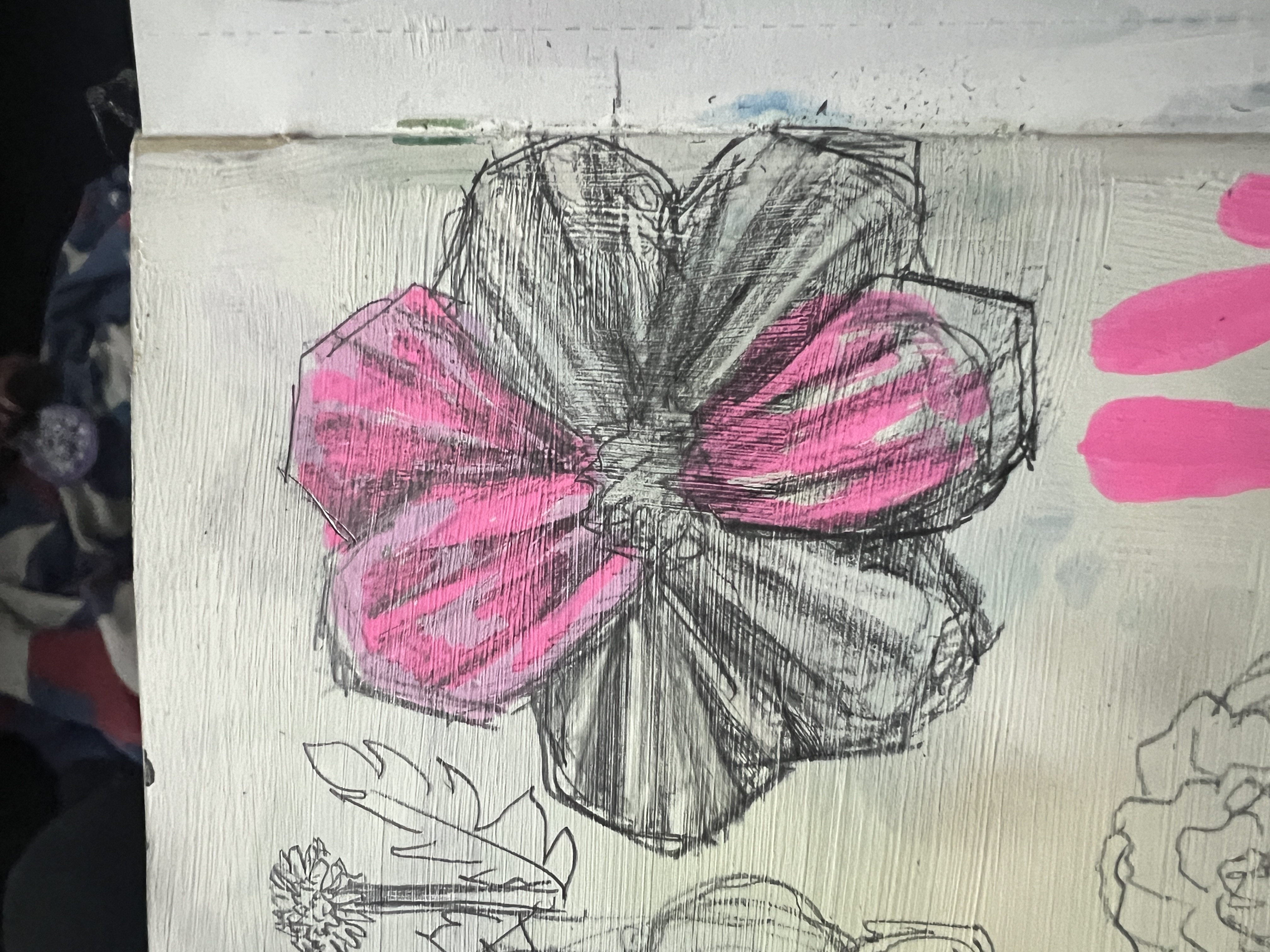
Description
Started: 04/22/26
Finished: In-Progress
A book of doodles and abstract art, experiments and fun.
Planning Notes
- 4/22/26 - I’ve been pondering the connection that Doodlecillian has to the Doodle Anatomy Sketchbook. I’m essentially starting the project over and I keep feeling like that means redoing everything exactly the same and having the exact same expectations but that doesn’t work. This is a new book, so it should be it’s own thing, and evolve in it’s own way. I copy/pasted the purpose and goals from Doodle Anatomy but I think I should start over. I think I should at least edit the purpose and rules to fit this new projecct and just dedicate this book to it’s own journey. For example, I want to do more realism than I initially planned but still with the focus of abstract art.
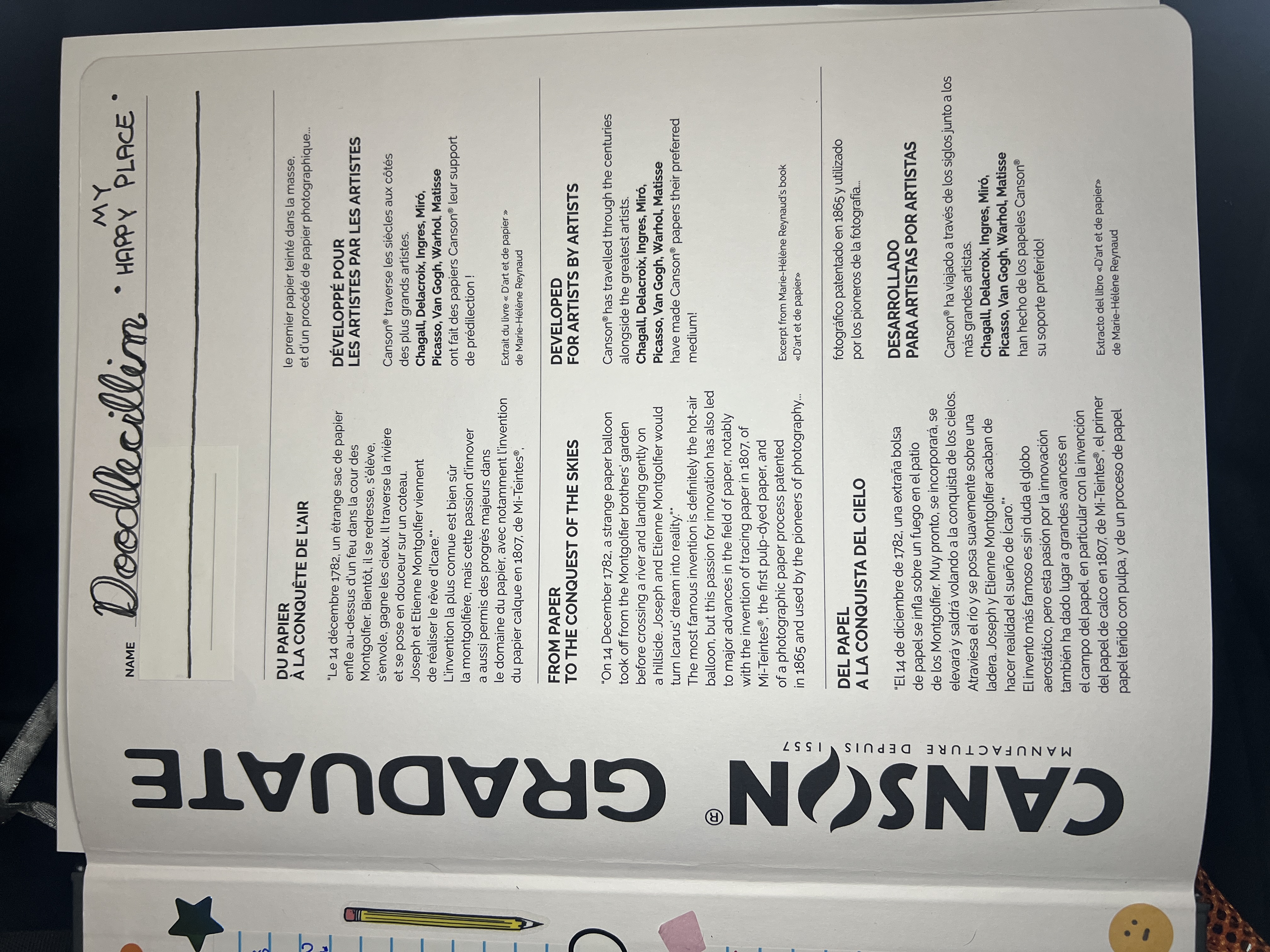
- I want to actually add my purpose and goals and ideas and etc to the front cover and early pages. The normal random sheet of a different paper quality is glued to the front and it creates a page of facts about the sketchbook from the company. IT’s also the page where you can write your name and phone number but I covered that with a sticker because I’m not putting my phone number in the book and want to use the space for something else. I’ll also use the first page as a title page.
- 4/23/26 - A thought just occurred to me as I started going through and edited the table of “spread” to make it into “pages”: I was planning to just do a lot of the spreads over as pages including the names, but the names already exist for other files and that means I wouldn’t be able to link the pages correctly…so then why would I keep the same names?? So I should have unique names for pieces in Doodlecillian.
- I’m going to change the name rule I had or Doodle Anatomy where I was only using single words for the spreads. In Doodlecillian I will open it up to include more words per title. Still short, but not restricted.
Progress Notes
- Finally started the book by doing the static front cover info along with a planning page for ideas and a title page.
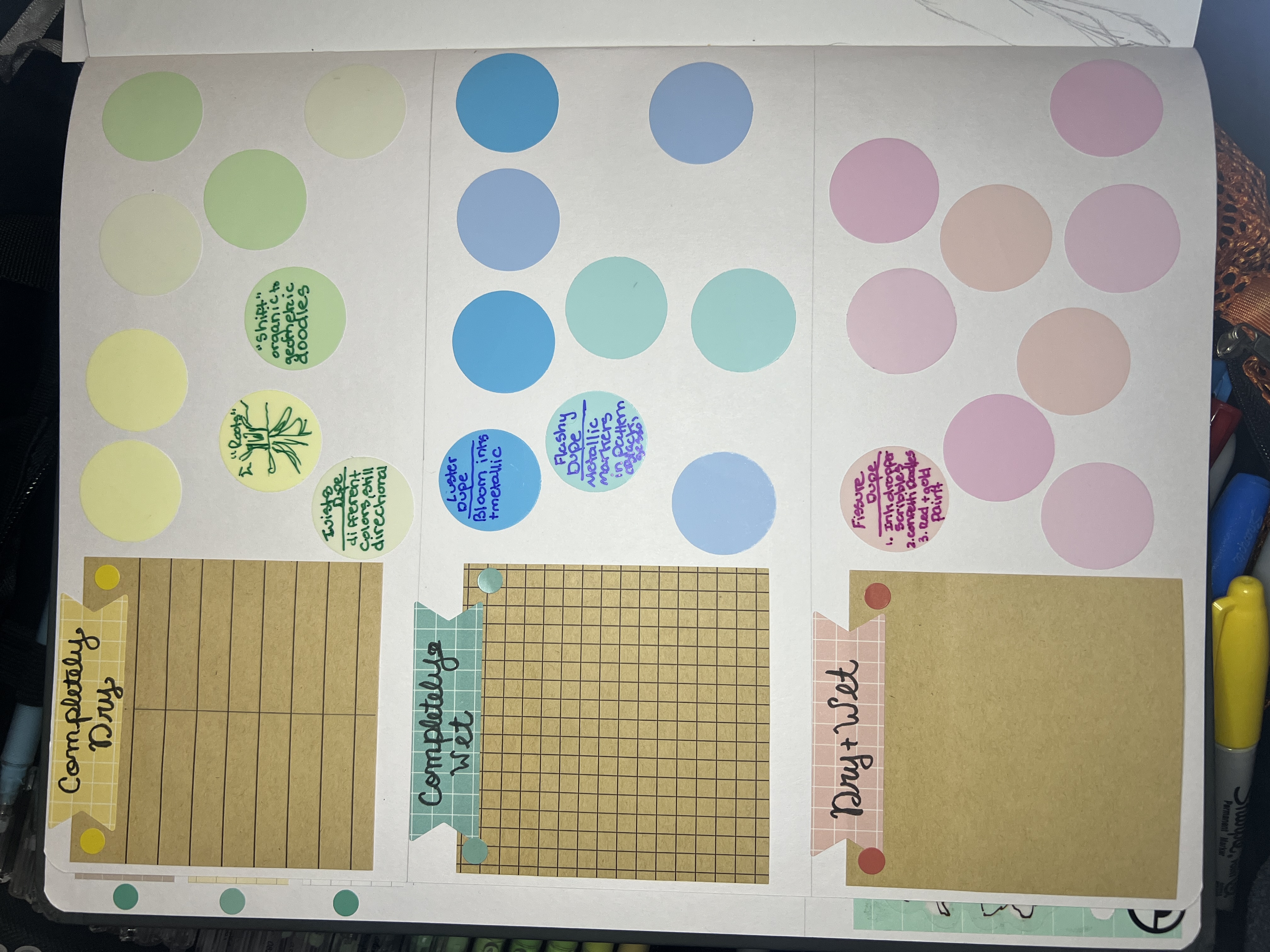
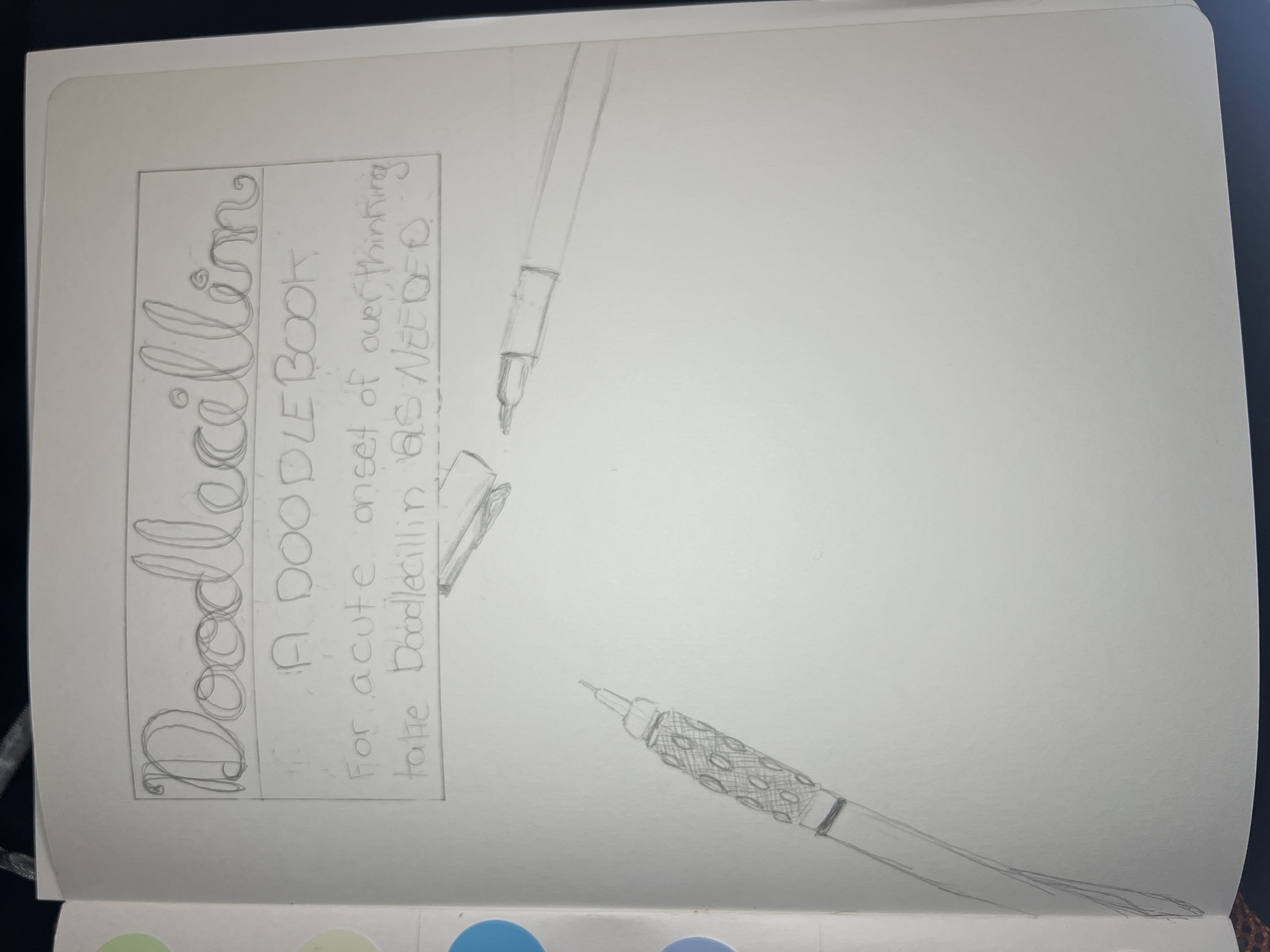
- 4/25/26 - I want to do pages in here that are just meditative in nature. “Guilty pleasure” doodles, ones that are fun to do, even if simple. I really like the Synaptic Weave technique whether it’s in ink, pen, colored, pencil, or markers. I could see myself doing more of that.
Completion Notes
- CONTENT
Spread Planning
| Title | Pages | Description & Planning | Meaning |
|---|---|---|---|
| 🎨 🎨 🎨 🎨 | 🎨 🎨 | 🎨 IN-PROGRESS 🎨 | 🎨 🎨 🎨 🎨 🎨 🎨 🎨 🎨 |
| Doodlecillin | p. 1 | Title page with catalog-style illustrations of all main tools used in the book new and ready to use. Tools: F pencil, Black fineliners, Colored pencils (subtle accents), India ink |
Starting the journey with brand new materials. |
| The Us | p. 2 | Using tempura paints, I want to paint The They while vibing to dubstep. Tools: Tempura paint sticks. |
The They will be the first page that isn’t a title. The They starts the book and he faces doodles. |
| Diatomaceous Confetti | p. 3 | A mix of organic and geometric shapes filled with designs and patterns. The shapes are about the same size and about the same line weight to have a uniform look while still feeling like a large mix of confetti. The “confetti doodles.” Tools: Pigma Micron (03) |
The basic foundation of my doodles. The mix from which all other doodle combos derive from. |
| ✅ ✅ ✅ ✅ | ✅ ✅ | ✅ COMPLETED ✅ | ✅ ✅ ✅ ✅ ✅ ✅ ✅ ✅ |
| 📝 📝 | 📝 📝 | 📝 PLANNED 📝 | 📝 📝 📝 📝 📝 📝 📝 📝 |
| Abstract leaves where the bright colors are over pink and the grayscale colors are over white. Tools: Acrylic markers. |
Content | ||
| String doodles and geometric doodles combined to look like a big knot of cables held in place and surrounded by strands of doodles. Tools: Content. |
My phone is my life. | ||
| Twisted ribbons starting lower left moving to upper right. Various sizes, colors, directions, intertwining. White background. Tools: Colored pencils (full rainbow spectrum) |
The feeling of bending and twisting to fit into others' expectations and perceptions. | ||
| Thick cracked cobblestone lines in India ink. Cracks inlaid with gold surrounded by red. Blank "rock" spaces filled with confetti doodles. Tools: Black India ink (dropper); Gold & red acrylic markers; Black fineliners |
Anxiety. Cracks represent fracture, gold/red is intense energy within, doodles are the persistent, busy mind filling the spaces. | ||
| Thick India ink spiral starting center moving counter-clockwise. Hairdryer blows ink outward into organic tendrils. Flowers and leaves grow from tendrils. Darker imagery in center transitions to lighter toward edges. Tools: Black India ink (dropper), air blower, black fineliners, colored pencils |
Neurodivergence and mental illness. Spiral represents cyclical thought patterns; growth and beauty emerge from chaos. | ||
| Soft crayon gradients blended seamlessly across both pages. Soft shapes and colors. Tools: Crayons (all colors) |
Taking a breath. Grounding in the present moment. A quiet, still point between intense explorations. | ||
| Geometric India ink lines filled with patterns done in acrylic pens. Tools: Black India ink (dropper), acrylic markers, colored pencils, colored fineliners |
Multifaceted nature of human experience; individuality and identity formed by countless unique internal patterns. | ||
| Eight black acrylic ink lines from each edge creating distorted checkerboard. Don’t know what else to do with this. Tools: Black acrylic ink, gold paint, acrylic markers, black and colored fineliners |
Unknown. | ||
| Splattered and gestural black and blue India ink. Gold gel pen doodles drawn over the blue ink. Tools: Black & blue India inks, gold gel pen, toothbrush for gold paint splatter |
Spectrums. The range between dark and light, matte and shiny, chaotic splatter and intentional doodle. | ||
| Black gesso base with grid of rounded square tiles. Each tile colored with acrylic marker like pixelated hex color selector. Black "grout" remains. Tools: Black gesso, ruler, 4h pencil Acrylic markers (full spectrum) |
Perfectionism. The pursuit of perfect grid and tiles is impossible. Beauty lies in the attempt and acceptance of imperfection. | ||
| Black gesso painted over whole spread. White gel pen for bottom left corner and as it goes up towards the upper right corner, the doodles transform from gel pen to dip pen to dropper, creating an effect of the doodles coming undone. Tools: White gel pens, black gesso |
My search for the unobtainable perfection. Also meltdown’s and coming undone. | ||
| Black gesso on left, white gesso on right. Gellyroll pens of the same colors on both sides making circles with swirls in them cover the page like the very first types of doodles I used to do. Don’t know what colors. Tools: Black and white gesso. |
My life in extremes. | ||
| Layered calligraphy of internal dialogue. Some words crisp (dry layers), others bleeding into each other (wet layers). Positive and negative words used in self-talk. Tools: Dr. Ph. Martin's India inks (whole set) + dropper |
Complexity of self-talk. The inner voice can be kind, cruel, or neutral, often layered and overlapping. | ||
| An entire pattern made of metallic doodles (acrylic marker). Don’t know what pattern. Tools: Atristro metallic acrylic markers. |
Trying to distract people of my lack of direction using flashy distractions. | ||
| The supplies drawn on the front page but now empty and used. Tools: Content. |
Ending the journey with well worn and used materials. | ||
| Geological cross-section with horizontal layers in different media and patterns. Irregular like real rock strata. Each layer represents a different "part" of self. Black and white doodles and patterns at the bottom, color slowly added by top. Tools: Black and colored fineliners, acrylic markers, India inks (whole set), colored pencil, crayons, watercolor |
Identity is not singular but composed of accumulated layers. Some dense, some fragile, all layered to build who we are. | ||
| “Stratified layering” technique creating the ripples and layers made by a boat cutting through a still lake, or like cutting through tall grass. May also take the form of wings. Start in center and go out (top down) Tools: Colored pencils |
Layers of experience, memory, and time that build upon one another to form foundation. | ||
| Gradient from organic/floral doodles (lower left) to geometric/angular doodles (upper right). Seamless transition with hybrid forms in middle. Black fineliner only. Tools: Black fineliners |
Change and growth. Transformation is gradual. | ||
| My glass “flower power” doodles but with the skills I have now. Tools: Black fineliners (range of nib sizes) |
Nostolgia and paying honor to where we came from. | ||
| Realistic tree trunk and branches above soil line. Below soil, roots transition from realistic to confetti doodles. Tools: F pencil lead, Micron 03 |
Foundation. What I am now is supported by the doodle foundation I started with. | ||
| The two pages of the spread are each a lung (left page = left lung). Trachea in the middle and realistic. One side is confetti doodles, other side is some sort of colorful chaos. Tools: Fineliners. |
Anxiety takes my breath away, just like love. | ||
| A disorienting maze. Outlined in fineliner, colored with colored pencil and/or acrylic markers. The maze has the follow properties: • Paths that change size from broad to narrow, or random curves. • Random traps • “Some of the arrows lie” • Tools: All kinds. |
Life is confusing. | ||
| Classic, old school zentangling patterns. Tools: Micron fineliners, faber-castell matte graphite pencils for shading |
This is where my doodle art truly started, so this is where I want to end the spreads. | ||
| Fleshy, alien-esque wall of undulating folds. Dozens of eyes with various pupils (human, cat, lizard) looking in different directions. Bright saturated colors. Tools: Colored pencils (acid green, tangerine, electric blue, magenta, violet) |
ADHD and focus. Dozens of threads of attention all looking at different things; true focus requires wrangling them to one point. | ||
| Content Tools: Content. |
Content | ||
| Poured ink for Di using Magenta, yellow deep, Hooker’s green, cerulean blue, and black. | |||
| White gesso mixed with red base. | |||
| White gesso with blue paint. |
Cycle of Creation & Destruction
04/20/26 - Today is the birth of the idea for this sketchbook. It came after I completely destroy my original Doodle Anatomy Sketchbook. I used too much water, ink, and gesso without properly drying or prepping the book before hand. I was too hard on it for too long and my impatience caused me to accidentally tear the book…and with it, my heart 💔
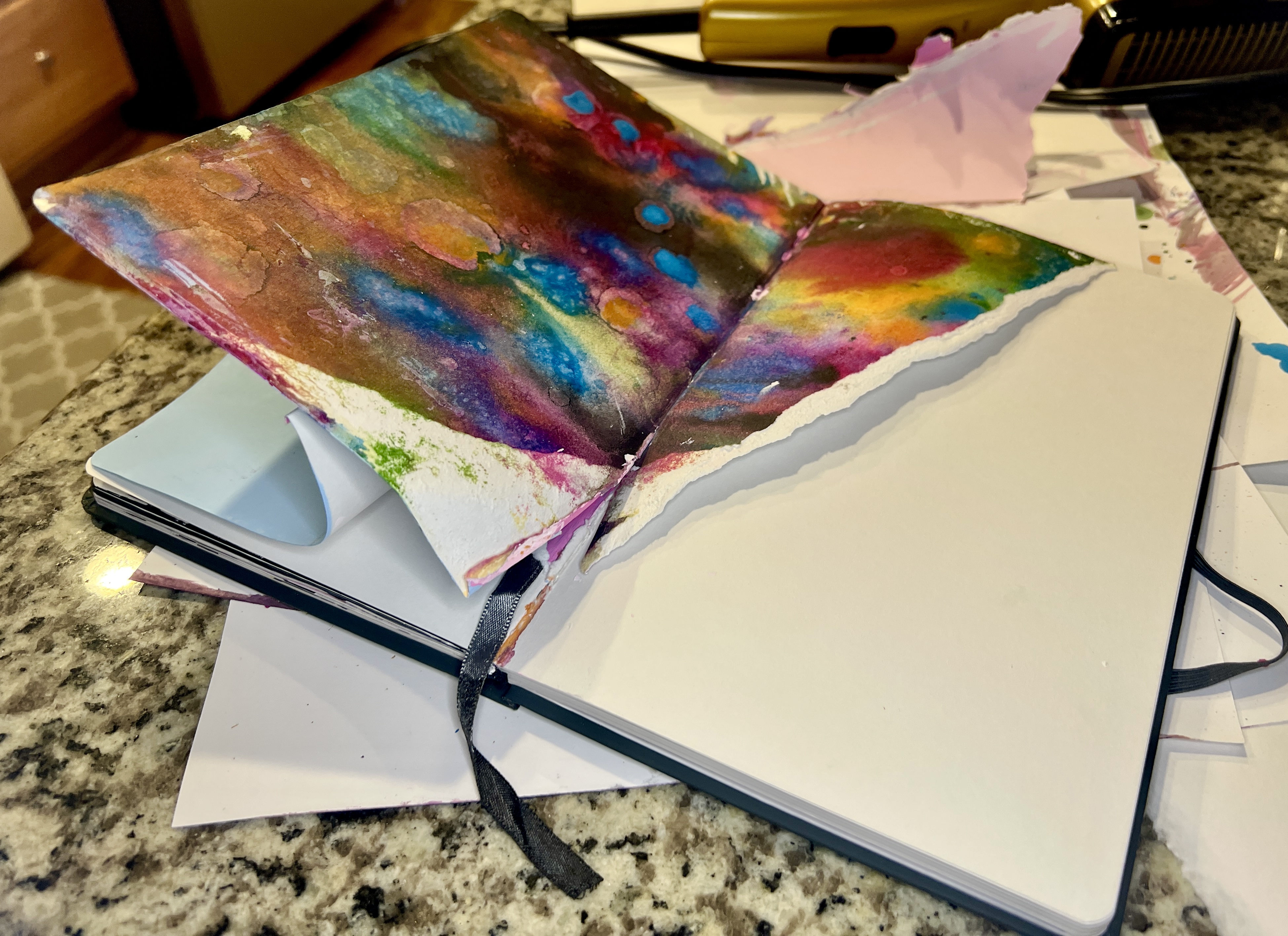
But every failure is a chance to learn, so what did I learn?
We Learn From Our Mistakes
Lesson 1
I am far too impatient with wet media like ink and standard paints. It’s why I love acrylic markers so much…they dry so fast! A few years ago I bought an air dryer that used batteries and was thus, portable, but it didn’t get hot. It literally just blew room temp air. It worked to speed drying but not by much.
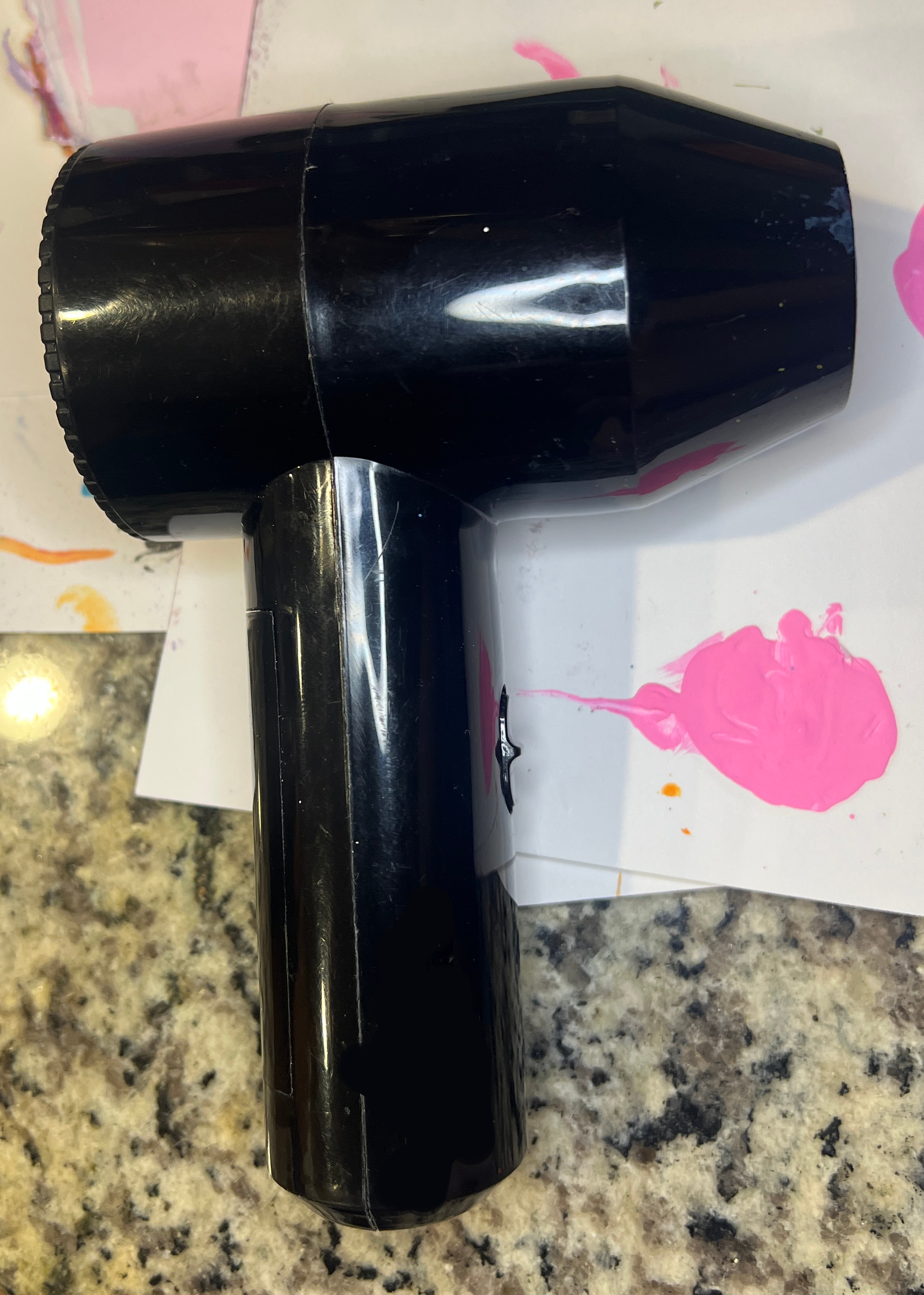
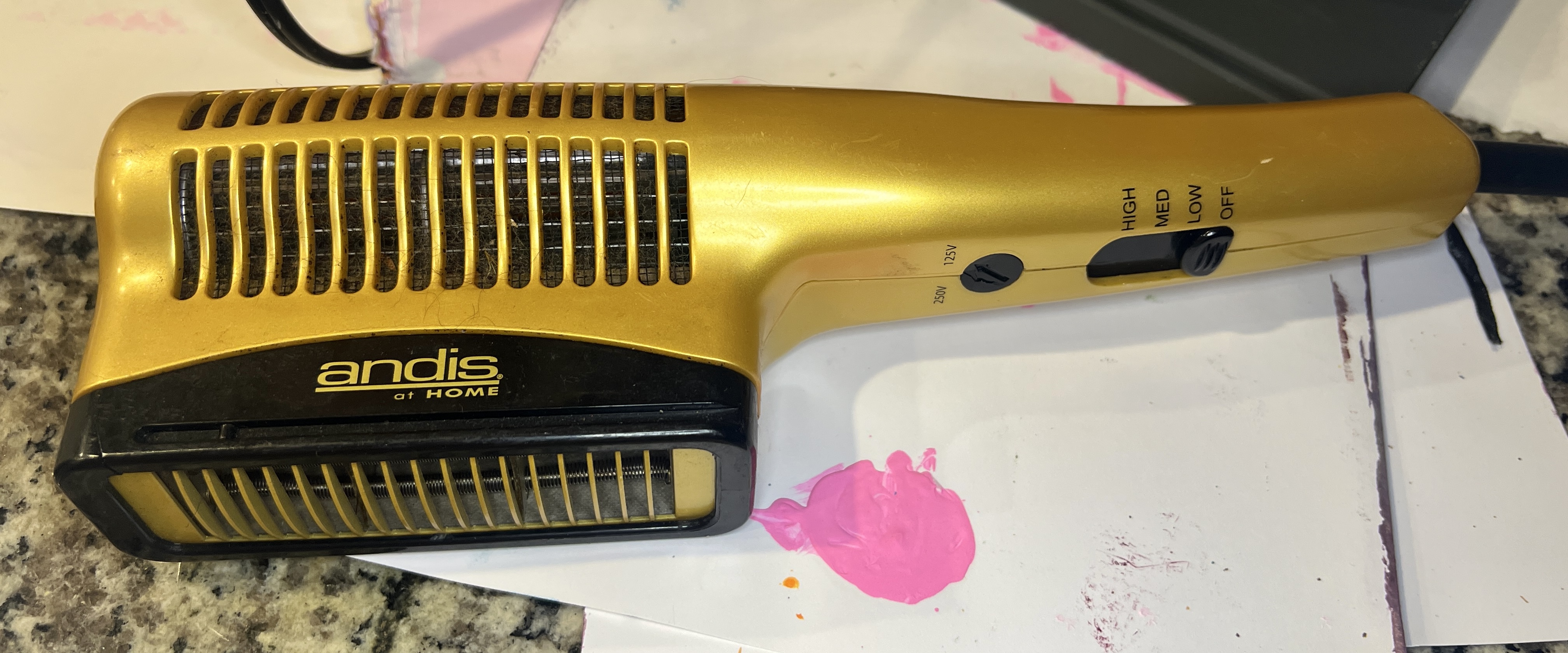
Luckily, Hubby found an old hair dryer under the sink! I liked having a portable dryer but now that I have something that actually blows heat, I can dry my wet media much faster.
Lesson 2
The credit card technique (using credit card to spread instead of paint brush) works but requires too much gesso for an opaque layer (as it takes multiple). Makes the book more unstable for when I need to be intricate with my doodles. The paint brush gives too much texture, but the credit card creates too much mess.
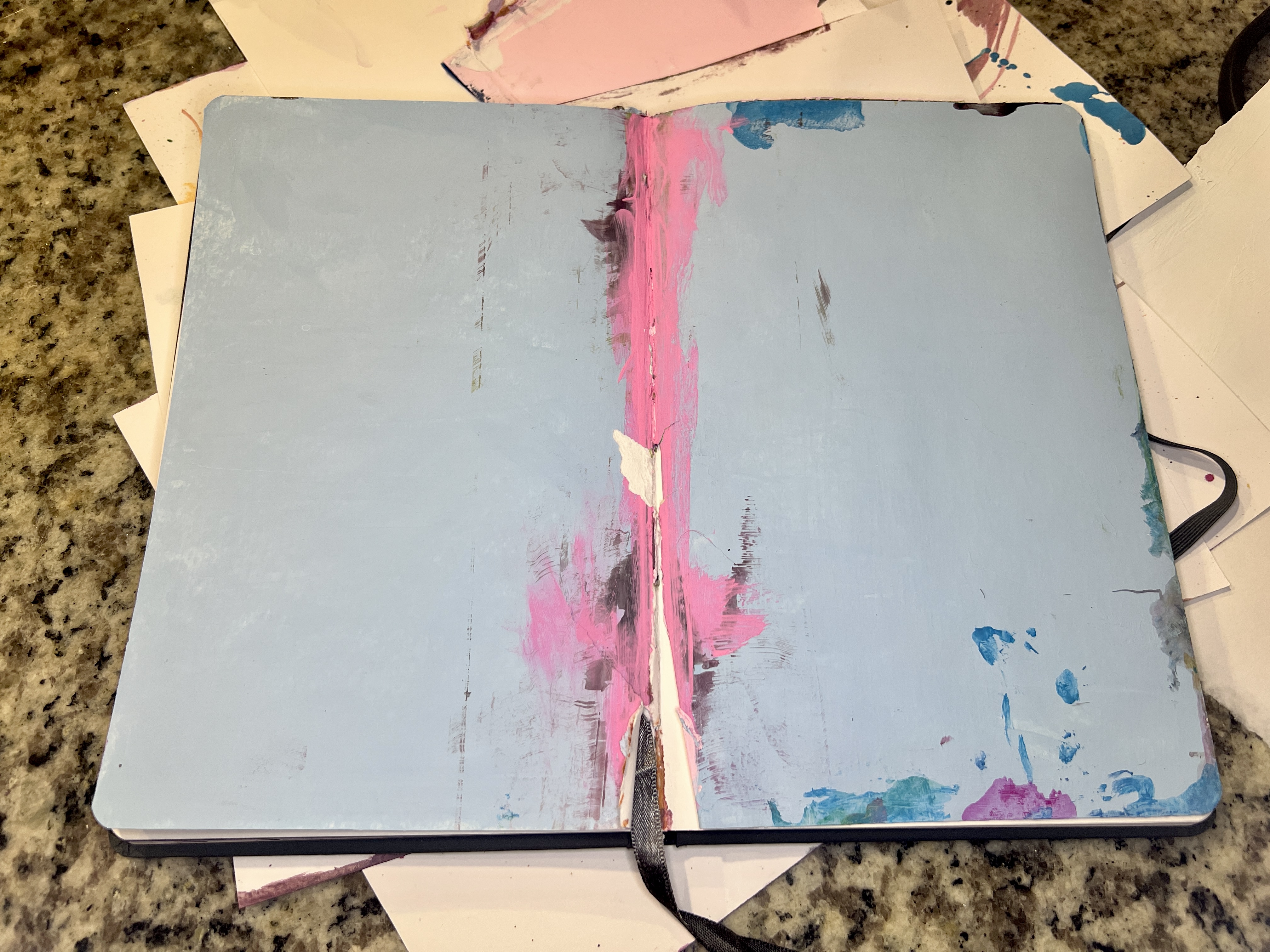
I started using the credit card technique to try and get a smoother finish with the gesso. But it creates such a big mess that ends up seeping between the pages and into the spine.
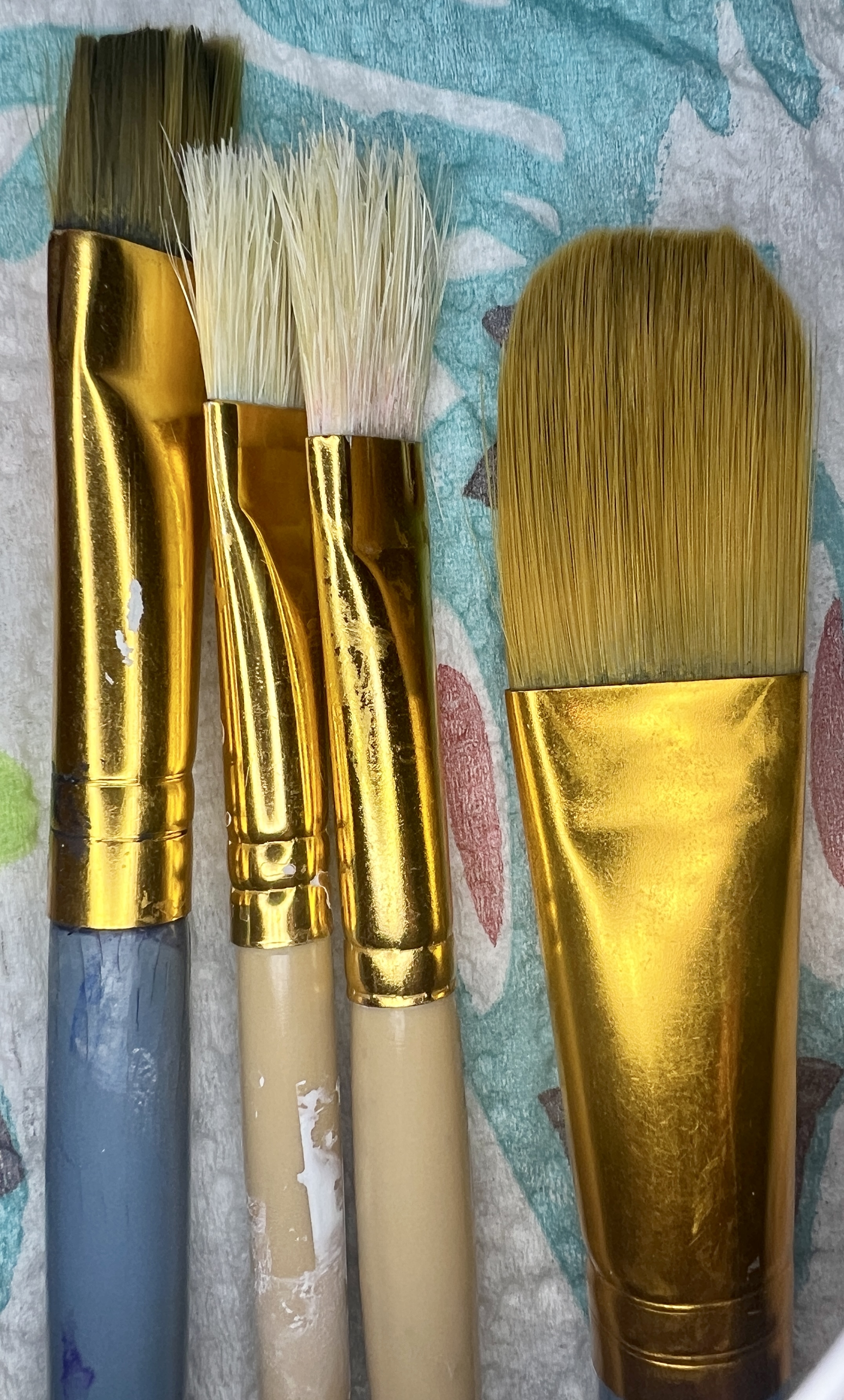
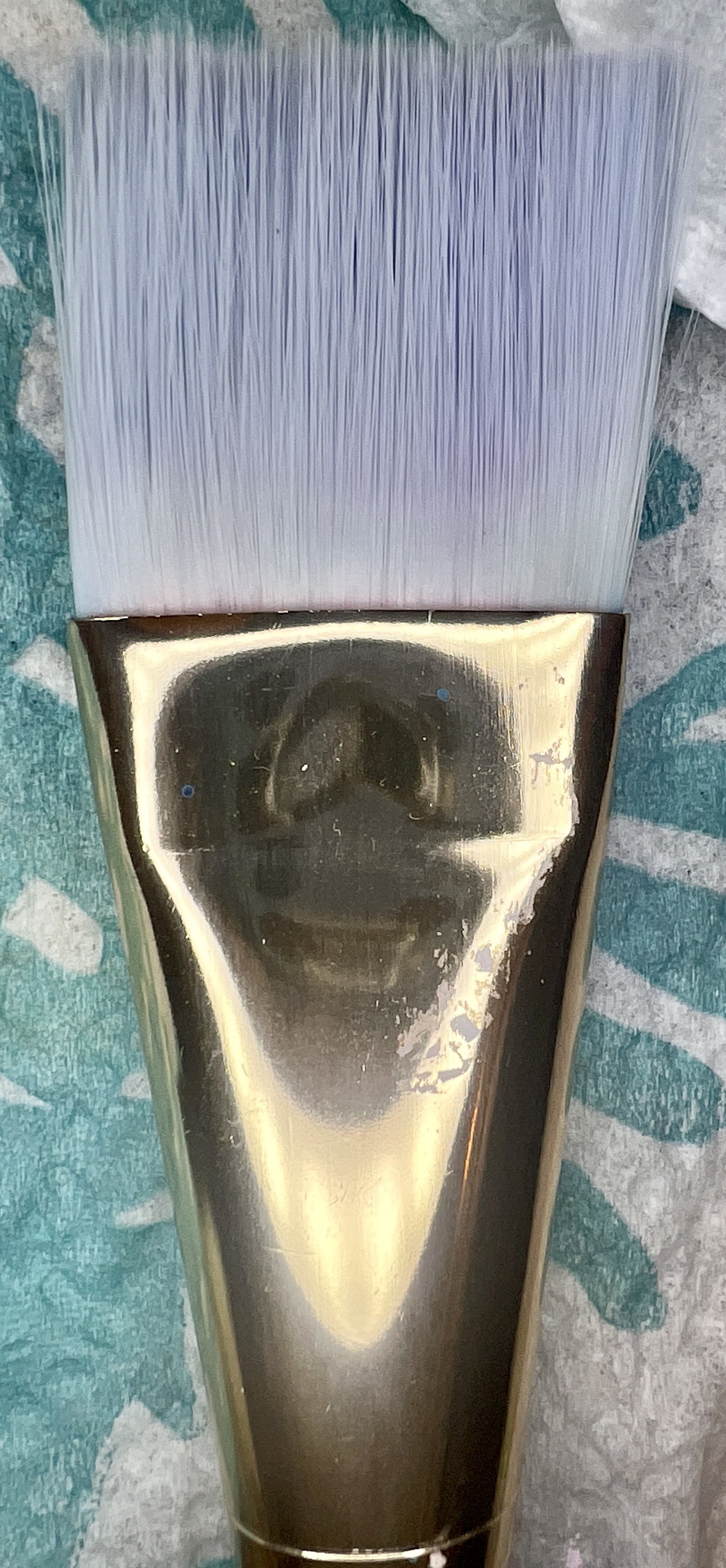
I went to the credit card technique because the brushes I was using (left) weren’t giving me as smooth of finish as I wanted. I’m going to try a softer, wider brush (right) and see what happens.
Lesson 3
Double page spreads are cool visually but much harder to work with practically. Wet media messes with the seams and thread, either weakening it or making it harder to close and busting out pages. There’s probably ways I could have prevented this but I don’t think my artistic process and workflow are conducive to being that level of meticulous. That’s too much linear thinking for me.
I also liked working in letter size (A5 double-page spread) as did my husband, so I decided to buy the same brand of sketchbook as Doodle Anatomy Sketchbook (i.e., the Canson Graduate Mixed Media Paper) but in the larger letter size (8.5 x 11). I’ve also decided to work on individual pages instead of an entire spread, effectively doubling the amount of art I intend to create in the book.
Shifting the Process
After some thought, the new “doodle book” (titled: Doodlecillian) is NOT a second edition or iteration of the original Doodle Anatomy Sketchbook, but a separate project. And although I’ve decided to keep most of the same goals, purposes, and planned spreads (I’m redoing ones I completed in Doodle Anatomy), I’m going to treat this sketchbook as it’s own thing, and evolve in its own way.